
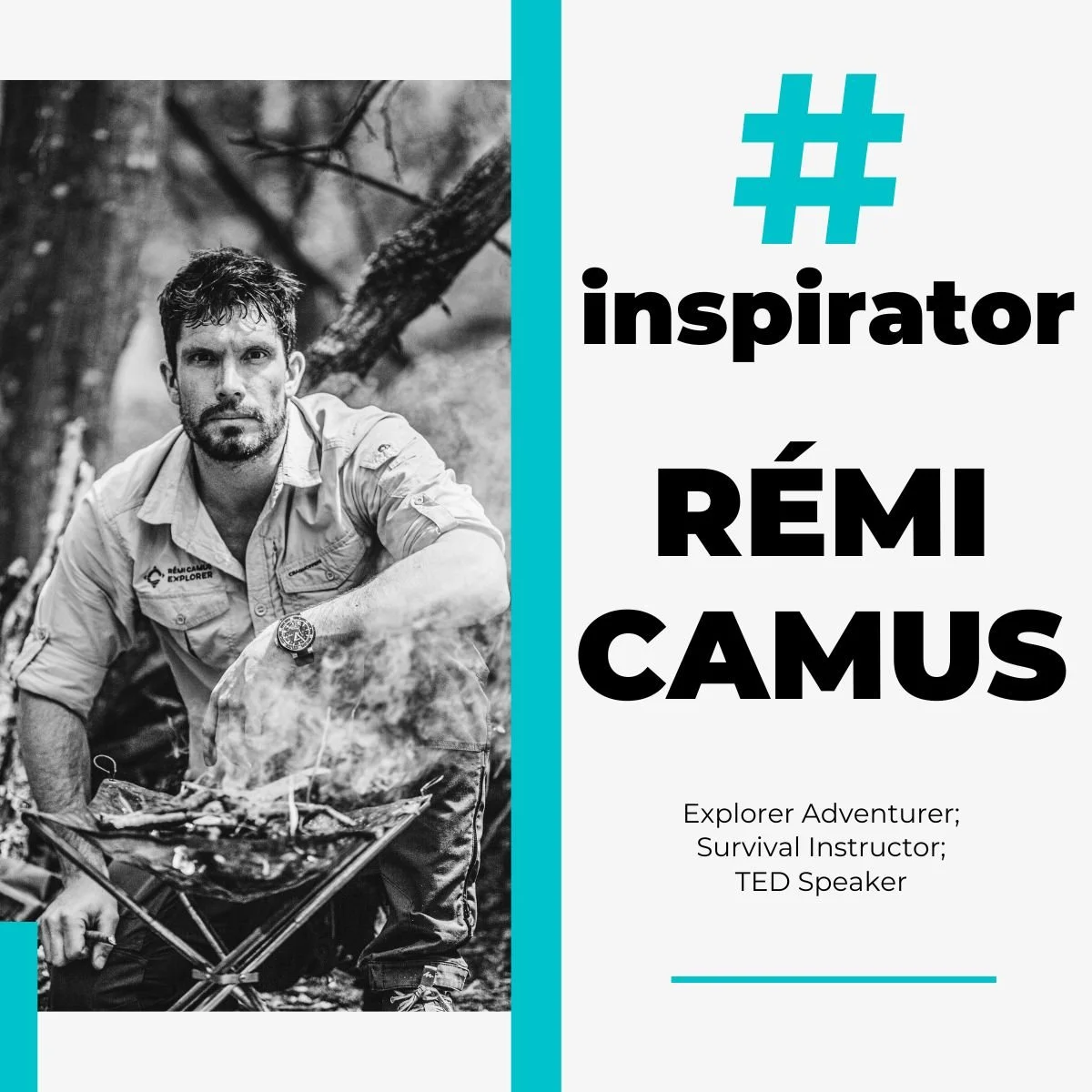
Rémi Camus
on Survival Instinct and the Power of Human Compassion
“Hard times create strong men. Strong men create good times. Good times create weak men. Weak men create hard times.”
You may have heard this one before. But how do we survive without losing our humanity? How do we confront fear without closing our hearts?
For Rémi Camus, it’s not just a reflection on the cyclical nature of history. It’s a call to be a circuit breaker. To dare and shift his entire trajectory.
He's an adventurer, explorer, survival instructor and TED speaker. But once he was a Maître d’hôtel in a Michelin-starred establishment, living a precise, structured life. Yet, something inside him was unsettled: “At 26, I was rather lost. I needed to discover who Rémi was. I needed to step out of my comfort zone, or, rather, to expand it.”
Adventure began unexpectedly at a flea market. Among forgotten stories, a book caught his eye and became the fuel to his inner fire: “Au cœur des Amériques”, the story of Jamel Balhi, who had run across the Americas. “I read it in one night. The next day, a project was born: ‘If he managed to do that, why not me?’ He’s not superhuman, so I can do it too.”
In 2011, Rémi crossed 5400 km of the Australian desert outback alone, fully self-sufficient. But the real crossing was existential. Each step became a confrontation with both the environment and himself. Survival stripped his mind and body into fragility, undressing his raw instinct to live.
It was water that taught him that resilience means doing things you never thought you could: “I never planned to focus on a particular theme, but I discovered what water scarcity means. What struck me was thinking: ‘I might die of thirst in the desert!’”
Two years later, he found the opposite of scarcity: abundance.
Descending the Mekong River over six months, he encountered communities whose lives depend on one of the most polluted rivers in the world. He saw hardship, political neglect, and climate damage. But what marked him most was solidarity: “I wanted to understand their way of life, what keeps them together while they survive along this river.” In all that uncertainty, what actually kept him alive were human encounters. Shared tears, silent embraces, and the discovery that even in the most fragile context, people find ways to help one another survive. The river was his kind teacher of human connection.
Rémi believes courage doesn't mean proving oneself. Caring about others, shared vulnerability, and the power of small gestures to sustain life and spirit are as vital as any survival skill.
Extreme experiences have a surprising way of returning us to the essence of our humanity. Survival is not synonymous with enduring alone. It’s discovering the depth of connection, especially in the harshest context.
Read Rémi’s answers for Inspirators and remember: survival is relational, always.
Thank you, Rémi, for being a Survival Instructor!
#INSPIRATORS QUESTIONNAIRE
Name: Rémi Camus
Company / Institution: Independent / Professional Explorer
Title: Professional Explorer & Survival Skills Instructor
Website: www.remicamusexplorer.fr
LinkedIn profile: https://www.linkedin.com/in/remi-camus-explorer/
Country of origin: France
Country you currently live in: France
Your definition of Regeneration: Giving back to the Earth and to communities what we take, respecting natural cycles and ancestral knowledge, and creating practical actions that strengthen the resilience of ecosystems and societies.
A challenge you are currently navigating in your work: I now collaborate with laboratories to provide concrete insights from my expeditions, particularly on persistent pollutants such as PFAS. Turning field exploration into actionable scientific data while staying true to the expedition spirit is a real challenge.
Main driver that keeps you going: What keeps me going is raising awareness and educating, especially young people, helping them understand the importance of protecting our ecosystems and taking meaningful action for the planet.
An ancestral teaching or Indigenous worldview that changed how you see life: During my first expedition in Australia, I lived with two Aboriginal communities. Their deep connection with nature, their simple and respectful way of life, taught me to return to the essentials and understand the impact of our actions on the world around us.
A human or more-than-human inspirator who shaped who you are today: I don’t have a single person in mind, but my father, despite his flaws and his disagreement with my choices, greatly influenced me. Proving that I could follow my own path gave me strength and determination.
The trait you are most proud of in yourself: Authenticity: I am true to myself and do not overdramatize adventure.
The trait you most value in others: Respect and sincerity.
Passions & little things that bring you joy: Hiking in nature, observing wildlife, campfires with my daughter, sports, and winter bivouacs, when the cold turns every moment into both a challenge and a source of wonder.
A meaningful place to start for those at the beginning of the regeneration journey: Start by observing and understanding the place where you live.
A particularly meaningful place for me was the Tibetan high plateau: mountains intersecting, encounters with monks in their temples, and the feeling of being both tiny and deeply connected to the natural world.
Most used and abused clichés in sustainability that bother you: “Don’t worry, it can be recycled.” This is often said without understanding the real limits of the processes and tends to shift responsibility away from concrete action.
An honest piece of advice for young people who lose hope: Don’t waste time waiting for perfect conditions. Try, even if you’re unsure it will work. Don’t let negative voices hold you back—listen only when there’s a valid reason or solid argument. Otherwise, focus on what you can do and trust yourself.
Must-read books that had a great impact on you:
· Miracle in the Andes: 72 Days on the Mountain and My Long Trek Home by Nando Parrado and Vince Rause
· Everest 1953: The Epic Story of the First Ascent by Mick Conefrey
· Into the Wild by Jon Krakauer
Movies or documentaries you love: The Bucket List – a reminder to live fully and intentionally About Time – showing the importance of valuing everyday moments.
Websites or podcasts you visit frequently: National Geographic – for nature, exploration, and scientific insights; Bivouac Stories – for adventure, survival, and real-life expedition tales.
Music that makes you (and your heart) sing: Queen, Guns N’ Roses, AC/DC – music that energizes, inspires, and reminds me of freedom.
Places you travelled to that left a mark on you: Uluru and Kata Tjuṯa in Australia, during my 2011 cross-country run; Yunnan, China, while meeting local communities during my 2013 Mekong descent; The Mediterranean Sea, when I crossed from Calvi to Monaco in 2023.
Global Regenerative Voices we should follow: People or organizations globally leading positive change for ecosystems and communities. I recommend following Vandana Shiva for regenerative agriculture and environmental activism, and Sarah Marquis for her deep connection with nature and human resilience.
Trends in Regeneration we should keep an eye on:
Community-led restoration projects;
Nature-based solutions for climate adaptation;
Integrating Indigenous and ancestral knowledge into environmental practice.
Events or gatherings we should attend for inspiration: World Wilderness Congress; Indigenous-led conservation gatherings; Local rewilding or ecosystem restoration projects.
Educational resources or courses you recommend: Indigenous-led environmental programs; Wilderness survival and field research courses; Online platforms like Coursera or EdX for ecology, conservation, and sustainability courses.
Reasons to feel optimistic about our future: Young generations are aware, engaged, and ready to act. Science and technology give us tools to restore ecosystems and communities. And there are countless stories of successful regenerative initiatives around the world.
Reasons to feel pessimistic about our future: Greenwashing, corporate lobbying, and political inaction continue to threaten ecosystems and undermine solutions.
Regenerative Leadership values much needed today: Authenticity and courage to act despite challenges. Humility, collaboration, and long-term thinking. Listening to Indigenous and local knowledge.
The Inspirator(s) you are endorsing for a future edition:
· Sarah Marquis
· Vandana Shiva
The quote that inspires you: “
"We do not inherit the Earth from our ancestors; we borrow it from our children.”
Your quote that will inspire us: