
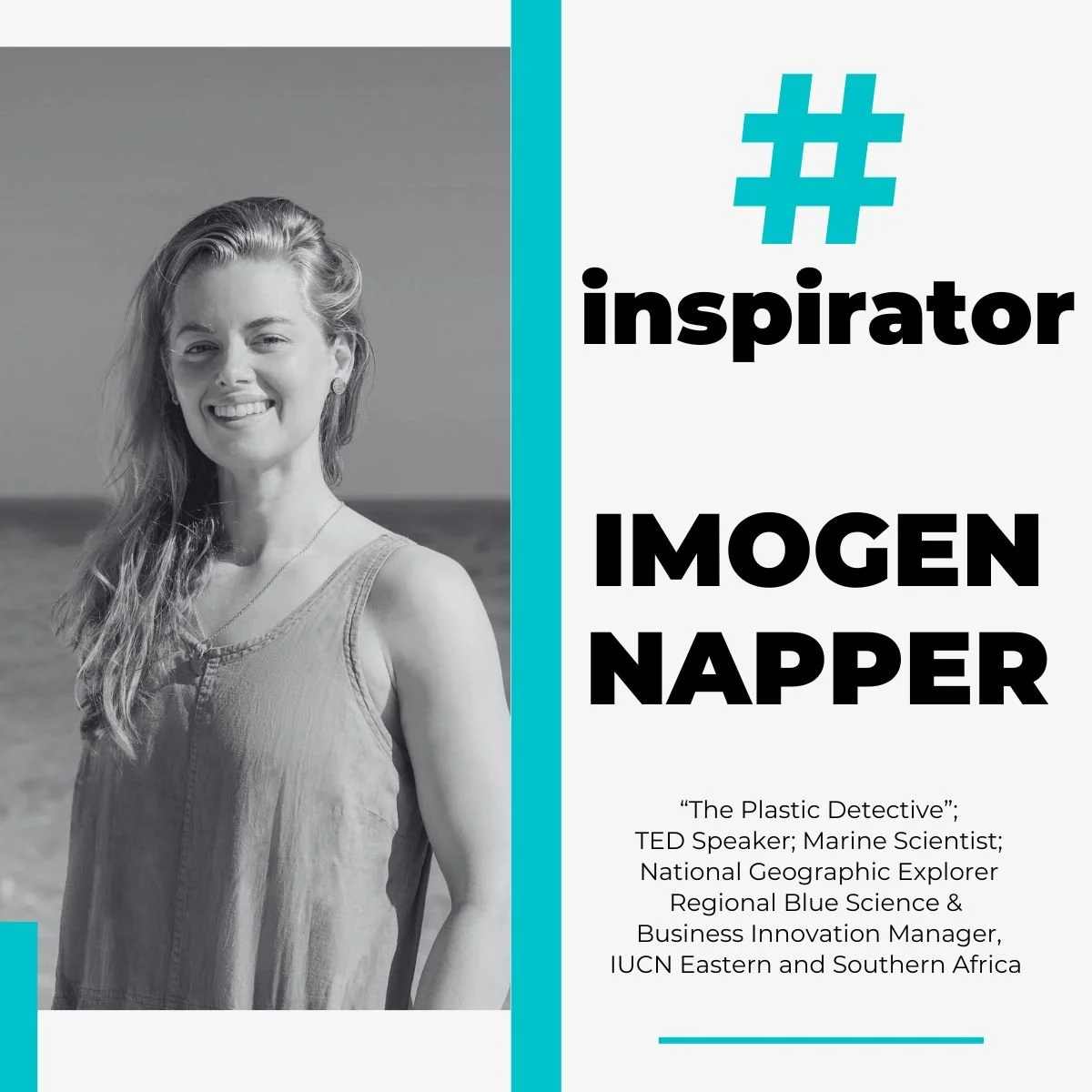
Imogen Napper
on being a Plastic Detective
Plastic. Or Plastikos. Or “capable of being shaped.”
Once a marvel, a miracle material that could become anything, endure anywhere, slip easily into every corner of life, an infinitely useful thing. Now, the victim of its own success. The very qualities that once made plastic extraordinary now sit at the centre of a global crisis shaped by excess.
“Plastic is an incredibly versatile, affordable, revolutionary material, but this convenience has come at a cost. Due to single-use plastic and our throwaway culture, we make over 400 million tons of plastic every year, and 3% of that is expected to go into our oceans. This will double by 2050 unless we intervene to stop oceans from turning into a plastic soup.”
Plastic does not disappear. It simply fractures into smaller traces of itself, microplastics that drift, settle and infiltrate everything.
Thankfully, the Plastic Detective is already on the case!
Imogen Napper, a TED Speaker, National Geographic Explorer, and Postdoctoral Researcher at the University of Plymouth, has made it her mission to expose the invisible pathways through which plastic slips into the environment. From the “Sea to Source” expedition on the River Ganges to investigations in laboratories, mountains, and oceans, she traces the problem to its origins. Then she asks the most important question of all: How do we stop it? “Plastic is still quite a new material, only 100 years old! Can you even imagine what it could be like in another 100 years? We are at such an important moment in time where we can make a difference.”
Her instinct to question the world began early. As a child, her favourite word was why: “I was a curious child, and that led to my love of science, which is answering unanswered questions!” A charity balloon release at primary school has been pivotal: 60 balloons released into the sky, only 5 were ever found: “I remember wondering ‘What happened to the others?’ No one knew where the others went or what impact they had!”
Most people picture a beach when they hear “plastic pollution.” But Imogen’s detective work began with something far more ordinary: face scrubs. Her research changed public awareness and eventually legislation, eliminating microbeads in products around the world. “That lit the fire for my research-obsession!” Then, she went higher to the very top of the world - an expedition where she brought back snow samples from Mount Everest that contained microplastic fibres: “I didn’t think we were going to find any plastic in that pristine, remote place! Plastic pollution is an overwhelming web to navigate, but we can’t unravel everything all at once. Like a detective, we need to take it bit by bit, to ask questions and gather evidence!”
Read Imogen’s answers for Inspirators and remember those curious moments in your childhood that shaped you!
Thank you, Imogen, for being a Plastic Detective!
#INSPIRATORS QUESTIONNAIRE
Name: Dr Imogen Napper
Company / Institution: International Union for the Conservation of Nature, Eastern and Southern Africa Regional Office
Title: Regional Blue Science and Business Innovation Manager
Website: imogen-napper.com
LinkedIn profile: https://www.linkedin.com/in/imogen-napper-a1348965/
Country of origin: United Kingdom
Country you currently live in: Kenya
Your definition of Regeneration: Adapting positively to change.
Main business challenge you face: Lack of funding for science.
Main driver that keeps you going: Knowing that science can provide answers to guide us in the right direction.
The trait you are most proud of in yourself: Trying to think outside the box to make science relatable.
The trait you most value in others: Passion and kindness.
Passions & little things that bring you joy: A good coffee, a curated playlist, and a perfect surf day.
The Inspirators who determined you to take the regenerative path: My Dad.
He was always obsessed with recycling, and some of my earliest memories are sitting in the car on Saturdays listening to Radio 2. He showed me that we can work to make a difference, no matter how small, and that it all builds up over time. Often we need to take issues into our own hands.
A starting point for companies or professionals that are beginning the regeneration journey: It always feels like the start of a journey, with a long distance to go. But when you look back, you see how far you’ve come and how much you’ve grown.
Most used and abused clichés in sustainability that bother you: “Greenwashing.”
Often, it’s linked to products that are more expensive, not scientifically tested, and provide no real benefit.
An honest piece of advice for young people who lose hope: Keep looking back and reassessing the path you are on. You can always shift into another path that makes you happy.
Books that had a great impact on you / Must-Reads for any regenerative professional:
· How to Own the Room by Viv Groskop— about how to communicate your thoughts effectively in different ways.
· The Penguin Lessons by Tom Michell — a true story about finding happiness in the small things in life.
Movies / Documentaries you would watch all over again: Blue Planet(documentary) and Back to the Future(favourite film).
Websites / Podcasts you visit frequently:
· Desert Island Discs — I love hearing how music has been important in people’s lives.
· New Scientist Weekly — breaking complex science into thought-provoking chunks.
Music that makes you (and your heart) sing: I’ve always been obsessed with old music, especially The Beatles. It feels so nostalgic to me. I have a Spotify playlist for every mood, but putting on a vinyl and listening to a whole album in the order it was meant to be heard is a great way to slow down.
Places you travelled to that left a mark on you: Living in the South West of the UK and exploring the South West Coast Path. I was constantly finding hidden gems (walking my dog, surfing, or swimming), and it has always been an incredible way to clear my mind.
Global Regenerative Voices you recommend us to follow: Giving more of a platform to scientists, locally and internationally, so they can share how their research can guide decisions.
Trends in Regeneration we should keep an eye on: Exciting but also scary is how we are going to have to adapt to new financing. The days of grants are depleting, but this gives us a great opportunity to redefine how we make financing more sustainable, rather than a 'one-and-done' grant.
Events we should attend / Best places for networking (online or offline): I actually don’t like forced networking, as it can feel so fake. Someone introduced me to walking meetings or doing something outside. If you can meet outside of the traditional office, conversations often flow more naturally.
Impactful and relevant Sustainable Development or Regeneration courses or certifications: Courses can be expensive, so I always weigh up what benefit I’ll gain. Keeping up to date with new technology (like drones) has been really useful, as it means I can expand my skillset into new areas.
Reasons to feel optimistic about our future in 2030: Building momentum, rising awareness and understanding, and prioritising our planet over profit.
Reasons to feel pessimistic about our future in 2030: Lack of action, lack of funding, and lack of ambitious global leaders.
Regenerative Leadership qualities much needed today: Tolerance, understanding, determination, and passion.
The Inspirator(s) you are endorsing for a future edition:
Hugo Tagholm (Oceana)
The quote that inspires you:
“If you think small changes can't make a difference, try sleeping with a mosquito.” (Dalai Lama)
Your quote that will inspire us: